Medicating Children

As the mother of a teenager with ADHD soon entering high school, I want to know the pros and cons of medication.  If you are a parenpill-1254786t reading this, you likely do, too.  And I will admit, I’m torn.

The research seems too unfinished for me to rely on it as much as I might like.

Consider that over 40 scholars from the UK, USA, Denmark, Italy, Germany, Switzerland and Australia will be reviewing  various “pharmacological interventions” to rank how well they work and their “tolerability profiles,” looking at these things for children, teens and adults.  The scholars note that “there is a lack of up-to-date and comprehensive evidence on how available ADHD drugs compare and rank” with regard to their ability to deliver desired results and to do so with tolerable side effects.  See more here.

But do we keep waiting for what seem to be more definitive answers? At what cost?

Consider this…recent research suggests that school could be a more rewarding experience for children and teens with ADHD who use medication for their symptoms.

Examining about 10, 0000 12-year-old twins, some who’d been followed since 7 years of age, researchers found that medication-free children with ADHD showed lower educational achievement than children with ADHD using methylphenidate (Ritalin, Concerta).  And the medicated children showed lower educational achievement than children without ADHD.  That is, ADHD appeared to lead to lower educational achievement but especially when unmedicated.  Plus ADHD symptoms predicted a negative educational trajectory from 14 to 16 years of age.  See study here.

Where does this leave us parents wanting our children to have the best chance at achieving what deep down really matters to them?

It leaves me leaning toward the test of experience.  I am willing to let my teen, when wishing to do so, swallow a pill as I (figuratively) swallow mine.

Meanwhile, I will keep combing the research….

Marijuana + ADHD = ?

My husband read my post below and, essentially, said, “Huh?” He suggested I keep it simple and get right to the answer to the question posed above.  Here it is:  A big-deal study showed that, contrary to expectations, marijuana (mj) had no effect on ADHD-related brain differences.  It had effects on the brain, of course, but these effects were separate from the effects of ADHD.  Details and other results, which are the ones of more interest to me, below.

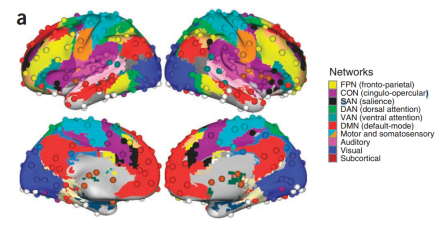
An impressive group of scholars got together to examine the mj + ADHD question using 21- to 25-year-olds followed since elementary school as part of a large multi-site longitudinal study of ADHD known as MTA.  Comparing mj users (who used at least once/week) & non-users with & without ADHD, the group expected to find that mj intensifies ADHD-related brain alterations.  They, essentially, thought mj would add insult to injury (the injury being the decreased “integrity of functional networks” seen with ADHD).
networks

But they found no one-two punch.

ADHD was associated with decreased integrity of functional networks responsible for executive function and somatomotor control, but mj affected different functional networks.

Interesting to me is that one of the mj-affected networks was the default mode network, which, when you have ADHD, fails to cooperate with the task-positive network (for more on this).  It raises the question of whether mj has an indirect effect on ADHD symptoms, even if no direct one.  (The other mj-affected network was the lateral visual one.)

Also interesting to me is that ADHD was associated with INCREASED functional network integrity for two networks:  1) “stronger integration of right posterior parietal cortex” within the dorsal attention network & 2) “stronger integration of left inferior premotor region within the cingulo-opercular network.”  For 1, think spatial orientation toward what’s relevant and, for 2, think maintaining alertness.

The researchers described the first strengthening (1 above) as “maladaptive” because of its association with slower processing speed for those without ADHD.

But they saw the second (2 above) as helpful and suggest it “may reflect a compensatory adaptation – the strengthening of connections or recruitment of additional brain regions” for the sake of “maintaining normal cognitive performance.”

In almost a side-note kind of way, they note that their data support that ADHD-related differences seen within the somatomotor network “are a good candidate for imaging-based prediction of ADHD diagnosis,” as suggested by earlier research.  Wow.

Actual study here.

Show & Tell or Hide & Seek?

When one has a psychiatric diagnosis, questions about revelation come up.  A search for answers around revealing ADHD brings up onhide-seeke:  It depends.

What’s the context (work, school, home)? What’s the situation? Who are the parties involved (believers, non-believers, agnostics)? What are the stakes? Ultimately, what are the real pros and cons, short- and long-term? For ADHD, the only time I’ve seen the answer clearly lean toward “yes, tell” is at school for the purpose of working out accommodations.

At work, the answer may largely depend on the work culture.  How much and what kind of diversity surrounds you?

How I wish we had more research examining the reality of telling vs. staying quiet.

Go, Go, Go and Slow, Slow, Slow?

A few years ago, researchers at MIT showed that adults with ADHD have two brain networks that compete for their attention instead of “playing nice,” as they do for adults without ADHD.  These networks are essentially a go, go, go one that lights up when we have a task to do (“task-positive network”) and a slow, slow, slow one that activates when we have nothing to do and can daydream or let our minds wander (“defccv-jp-ngault mode network”).  Without ADHD, when one network has its turn to be active, the other one turns down…they cooperate.  With ADHD, they appear to often be active at the same time.  Imagine what that’s like.  If you have ADHD, you already know.  If only others could experience your brain to know what it’s like….

See for yourself.

Hello Stars, My Old Friends

This past weekend I attended a workshop on gratitude and joy at Esalen Institute on the coast of California near Monterey.

In the deep darkness, I looked up at the stars and felt awe and sadness as I noticed constellations I had long forgotten.  It’d been several years since I’d seen them and I remembered how much I once loved them and loved space…knowing our world is much bigger and we much smaller than we usually acknowledge.  20141026_d7000web_4604

The stars, when I can see how numerous and bright they are, remind me to focus on what really matters…our connections to each other however far apart we are.  We all love, we all suffer, and we all have the light of stars showing through, or beyond, the deep darkness above us.

This weekend, I am grateful for the stars, the deep darkness that let me see them, and for the reminder that they have been there all along.  For all of us.

P. S. James and Jane Baraz led the workshop.  James is co-author of Awakening Joy (link is to his blog).


Accomplishment or What Might Have Been?

Some intentions turn into accomplishments and some drift to What Might Have Been.  What guides intentions one way or the other?

Yesterday, I remembered one guide when my guitar teacher asked me to perform publicly three weeks from now:  a time-limited goal, with accountability.  I have practiced the song I am to play, on average, five minutes every two weeks for the last three months.  My goal has been to playwpid-4813 the song eventually and sooner rather than later.  Yesterday, “eventually” became three weeks from now.  And, with this goal change, I scheduled a daily practice of at least 10 minutes.  This is the power of a goal that has a near-future deadline…combined with accountability.  My guitar teacher is counting on me and there will be an audience…my guitar-playing just got real.

Where can you add a near-future deadline plus true accountability to shift an intention toward accomplishment and away from What Might Have Been?

Blog at WordPress.com.

Up ↑