ABCs and 123s of ADHD

This is an overview of ADHD (Attention Deficit and Hyperactivity Disorder), primarily numbers and names.

123s…

What’s the prevalence? It’s estimated to be about 5-6% of the world population of children and 3-4% of the world population of adults (using DSM-IV criteria, DSM-5 criteria increase the estimates slightly). It’s estimated that about 1-2% of children without childhood ADHD may meet criteria for ADHD after 12 years of age. This suggests that about half of the population of adults with ADHD develop it “late.”

123s and ABCs…

When did the first formal description of ADHD appear, albeit under a different name? One best guess is 1798 by Alexander Crichton. Dr. Faraone at SUNY Upstate Medical University suggests it goes back even farther…to Weikard and a 1775 German medical textbook. See https://adhdinadults.com/a-brief-history-of-adhd/

Fast forward to 1968, when it became an official diagnosis here (the U.S.), being added to the DSM-II, clinicians’ reference for diagnoses of mental disorders. It was called Hyperkinetic Disorder of Childhood. The name changed over the years but the essence of the disorder as one of childhood hyperactivity, impulsivity and wayward attention remained.

In 1980, the DSM-III came out and added specifics to the diagnosis, such as indicating that symptoms had to appear before 7 years of age. There was no research showing that 7 was a magic number; only enough clinicians believing this made sense.

In 1994, the DSM-IV softened the age of onset “rules” requiring only some of the symptoms to appear before age 7. Subtypes were also added. It was during the 1990s that Adult ADHD became recognized as a valid disorder.

In 2013, the DSM-5 changed the requirement that symptoms be present before age 7 to before age 12.

WHAT IS IT? ADHD is a self-regulation disorder. Regulation is, essentially, flexible self-control described by 4 Ss: starting, sustaining, stopping and switching attention, action, motivation, and more. It is understood as a neurodevelopmental disorder, which is to say it is a way that the brain (“neuro”) develops that affects, more than anything, self-regulation, essentially, decreasing it compared to what’s seen for those without ADHD. And here’s the disorder part: It is associated with distress and/or dysfunction, including poorer results at school and work, higher levels of health-risking behaviors, and being less satisfied with oneself.

What Causes It? It’s believed to result from certain combinations of genes and environmental factors. Genes are believed to be necessary and… insufficient. So are environmental factors. This means you need both.

Sources:

https://www.ncbi.nlm.nih.gov/pubmed/?term=annual+research+review+does+late-onset+attention-deficit


https://www.ncbi.nlm.nih.gov/pmc/articles/PMC3000907/

Relationships: Turning Toward or Away

I know relationships from both a work and personal perspective. What I want to share as a level-2 certified PACT therapist (https://thepactinstitute.com/dividedpage/what-is-pact/) applies to intimate relationships with or without the influence of ADHD. PACT stands for Psychobiological Approach to Couple Therapy (fancy, I know).

When a couple enters into troubled territory, its members can turn to each other for solace and connection, right? Even when the trouble is each feels hurt and misunderstood by the other.

Right? Yes, some couples can. The secure functioning ones. The ones who understand that their relationship depends on this.

Many couples, however, do the opposite. They turn away. Each member feels too hurt, misunderstood, blamed, and afraid. Afraid of more of hurt, more of the same. Too caught up with thoughts of how the other one should know. Should know what I’m feeling, what I want. My hurt and mind. So the members turn away from each other and toward others and other interests to meet his/her own needs. One goes out with friends. The other delves into a creative venture. One joins a club. The other travels alone. Again and again looking outside the relationship for more and more. Each, little by little, turning away, and forgetting how to turn toward, each other. Until…it’s over.

If this is your relationship and you want to turn it around before you and your lover/partner/spouse kill it, try turning toward. Start by doing this physically. Get face-to-face, eye-to-eye with your partner, close enough to see each other’s pupils. Hold for a few minutes. Keep your faces soft and friendly. It may sound simple but can be really hard for couples to do. So no judgments. Of yourself or your partner. Approach it playfully. Then rinse, wash, repeat, as Stan Tatkin, the developer of PACT, likes to say.

My hope is that, for each member, this may be a start to turning toward, and getting to know, the person you once loved fiercely and may find yourself loving fiercely again.  

Two Awesome ADHD Resources

One resource focuses on children and teens; the other is for adults. Both can be remarkably useful for those with ADHD.

The first is understood.org (here) for “learning and attention issues.”  What it offers is vast and, though, it’s targeted to parents of children and teens with ADHD, many adults with ADHD can find it of use. Much of what’s suggested for teens applies to adults, except for the context (e.g., work vs. school).  Also, given that 25-35% of parents of youth with ADHD are likely to have ADHD (source), parents using the site may want to use the recommendations for themselves as well as their children.

The second resource is JAN, Job Accommodation Network (here), which is all about workplace accommodations for employers and employees needing or wanting to know what the American with Disabilities Act (ADA) encompasses, including job coaches…even the possibility of free ones.  Who knew? From what I can tell, fewer than would have liked to have known.

I hope something here is of use to you.

Mindfulness & Psychoeducation: “Everybody has won, and all must have prizes”?

The Dodo bird quote from Alice’s Adventures in Wonderland came to mind as I read the results of a recent study.  A randomised, controlled fMRI study of the effects of mindfulness and psychoeducation on the working memory of adults with ADHD found they both worked (for more on working memory, see What predicts ADHD symptom reduction over time?).  art-creative-flying-17679.jpg

After 8 wks, both interventions were found to increase working memory performance and to increase task-related right parietal lobe brain activity to a similar degree (study here).  Although I’d like to see the results for a third group who received neither intervention (to rule out any placebo effect), the good news is that, under both conditions, working memory increased.  What would be interesting to see next is what happens when we combine mindfulness and psychoeducation.

ADHD and Relationships

We know intimate relationships are hard.

When you have ADHD, they’re even harder.

How so?

Research suggests discontent and disloyalty among the reasons, but, hold off on nodding knowingly.  The discontent and disloyalty may be on a different side than you imagine.

Research suggests that it’s the partner with ADHD who’s likely to be unhappy.  Again, the one with ADHD (the opposite of what many might guess).

One study found that adults with ADHD had more negative perceptions of their relationships and families than their non-ADHD spouses did.  These perceptions were also more negative than members of couples where neither had ADHD (see here).

Research also indicates that ADHD’s associated with a higher rate of infidelity.  One study delved into this a little and found that “relational alternatives” were of “greater interest” when adults’ inattentive symptoms were high (see here).  (This same study found that when either inattentive or hyperactive-impulsive symptoms were high, adults showed “less constructive responses” to a partner’s “bad behavior.”)

There’s more, but the picture painted is that relationships are harder.  Namely, harder to sustain (versus start).

So does this mean couple therapy early on? Probably a good idea.

But choose carefully.

Some couple therapies depend on out-of-session assignments, and this could be a set up for failure.

Fights might become about who does the homework and how much of it.

Some couple therapies, however, focus on experiencing useful ways of relating during the session.  When my group members ask me about couple therapy, this is the kind that I suggest.  One of these is Psychobiological Approach to Couple Therapy (PACT).

There’s no research-tested ADHD-specific couple therapy of which I am aware.  Instead, there are therapists who understand ADHD and offer couple therapy/counseling.

One of these is Melissa Orlov, the author of The ADHD Effect on Marriage.  Her book describes common patterns of relating between partners when only one has ADHD, and she offers couple counseling through her website (here).

Whatever you choose, I wish you happiness.

MIT & NYU Study: Your Input Gatekeeper may be to Blame for your “Distractibility”

Some people with ADHD have a Ptchd1 gene mutation (more often these are males).  MIT and NYU scholars studied the Ptchd1 gene using mice and discovered that its loss may be the basis for symptoms of ADHD (as well as autism spectrum disorder and schizophrenia).

telephone-1822040_1920

Why?

Because its loss most significantly affects the part of the brain responsible for keeping out sensory input that’s irrelevant.  This part of the brain is the thalamic reticular nucleus (TRN).

According to one of the senior authors of the study, the TRN determines what input reaches the cortex, where thinking and planning occurs.  “We receive all kinds of information from different sensory regions, and it all goes into the thalamus,” Feng says. “All this information has to be filtered. Not everything we sense goes through.”

Except when Ptchd1 mutations lead to TRN defects.  Then, more of everything can go through, leading to, you guessed it, being distracted and overwhelmed.

Can you imagine no filter or one that loosely functions? For some, there’s no need to.

Last year, the prestigious science journal Nature published the study.

Find a summary of it here.

How to Make ADHD worse

When you have ADHD, here’s your recipe for disaster:  Mix sleep deprivation with carnival food.  Deep fry.

Hold the physical exercise and Omega-3s.

No one says, “I want to be my worse self.”  Yet many of us are doing exactly what we need to get us there or keep us there.

When you have ADHD, sleep deprivation makes your symptoms worse, carnival-like food makes your symptoms (particularly forgetfulness) worse and lack of physical exercise and Omega-3s keeps them from getting better.

If you want to give yourself the best chance at optimal brain functioning, here’s the winning combination:  sleep enough, eat healthy food (including Omega-3s), and exercise regularly.  This is true for all us but is essential when you have ADHD.

Consider that chronic sleep deprivation looks like ADHD.  Imagine what happens when you combine them.  Check out recent research on ADHD and circadian rhythms here.

Omega-3s matter so much, there’s even an Omega-3 prescription for ADHD called Vayarin.  See specifics on the Omega-3 and ADHD connection here:  Something Fishy.

For a recent review and meta-analysis on use of Omega-3s for ADHD, go here.

As for exercise, namely cardio exercise, check out this recent review.

Try the winning combination for even just one week and see what you notice.  I bet your brain will thank you.

Book Review

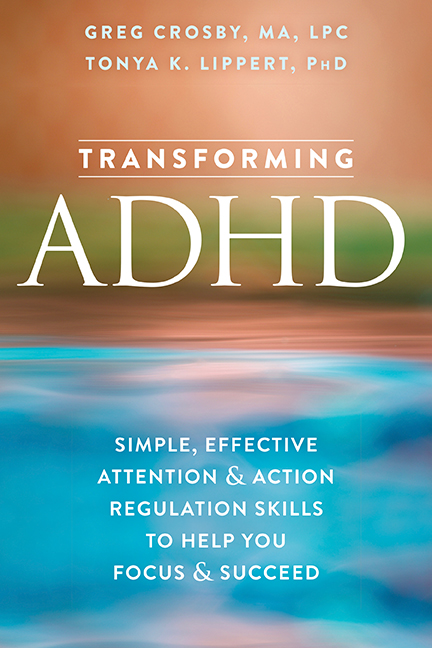
TransformingADHD-MECH.inddI found two reviews of the book I co-authored. The first one is below, which I posted before. It’s so interesting to find reviews instead of having reviewers let you know of them. Never would have known except for a search for something related to ADHD that led to this review awhile back and the other a few weeks ago.
Book Review:

Transforming ADHD

ADHD is not as it sounds — an attention deficit disorder.

According to the authors of Transforming ADHD: Simple, Effective Attention & Action Regulation Skills To Help You Focus & Succeed, Greg Crosby, MA, LPC, and Tonya K. Lippert, PhD, ADHD is a difficulty regulating and adjusting attention to fit the situation you are in.

Guided by the interdisciplinary approach known as interpersonal neurobiology, Crosby and Lippert show that ADHD is about much more than simply learning to pay attention. It is about successfully navigating and recognizing the external and internal environments that influence attention.

“The biggest confusion about ADHD seems to stem from its reference to a ‘deficit.’ As ADHD scholar Hallowell and Ratey (2005) said to refer to an attention deficit when speaking of the experience of ADHD ‘completely misses the point’,” write Crosby and Lippert.

According to the authors, attention is biased — that is, it moves toward some things and away from others. For those with ADHD, it’s not that attention itself but the flexibility or control of attention that is lacking. The result of this low attention regulation, is not just over-focusing and under-focusing; it also effects how we sustain effort and manage emotions.

One biochemical reason people with ADHD may have difficulty paying attention to what is not exciting is because they have lower levels of dopamine. Low dopamine function in turn leads to behaviors that seek to compensate for dopamine deficiency.

Crosby and Lippert offer helpful tips for those with ADHD to learn to place their attention where they want. Learning what they call the four S’s of attention – starting, sustaining, stopping, and shifting – can be helpful. Next, by paying attention to what activities attract and detract attention, and pairing activities of low interest with those of high interest, those with ADHD can practice sustaining attention when it might otherwise wander.

A person’s environment can also have a significant impact on his or her ability to pay attention, according to the authors. They write that part of becoming successful with ADHD involves designing your environment for optimal attention and action regulation.

“When it comes to long-term goals, (designing your exterior environment to work with your interior environment) means introducing representations of your desired future into your present by, for example, taping pictures of your desired home on your computer screen if your impulsive purchases occur online,” write Crosby and Lippert.

They also offer some other examples of environmental design such as closing yourself into a room where you are less accessible to the dog, wearing headphones, working away from home or taping an assignment list to the side of your computer monitor.

Another practice, which Crosby and Lippert call Introduce Results of Tomorrow Today (IRTT) helps those with ADHD overcome urges that draw attention away from the long term results they want.

Crosby and Lippert tell the story of Zelda, who had tried and failed to quit cigarettes many times. It wasn’t until she made a pact with a close friend that if she smoked she’d have to give $5000 to the KKK that Zelda was able to quite for good. This practice is a powerful way to maintain personal accountability, and also to learn that with a little effort, it is possible to design an environment that improves attention and action regulation.

Those with ADHD can also adopt healthy behavior to change not just attention and action regulation, but the gene expression related to them – which is called epigenetics. Crosby and Lippert cite one study where exercise was shown to affect the gene expression within cells throughout the body – brain, heart, bone, muscle, mouth and fat – including directly altering fat formation. One helpful brain exercise the authors recommend: Replace multi-tasking with mindful-tasking.

Understanding relationships and the neurobiology between them is also important in managing ADHD. One important reason, the authors write, is that people with ADHD have higher rates of insecure attachment as children, which predisposes them to poor self-regulation.

While we can’t rewrite our childhoods, what we can do is better understand our attachment patterns (for which the authors offer a helpful quiz) and then shift to security through reflecting on our childhood and practicing mindfulness.

Learning to communicate more effectively is also fundamental for people with ADHD. The authors suggest practicing mindful listening, paraphrasing, and what they call “urge surfing” or learning to notice — but not respond to — urges within a conversation.

“When you surf an urge, including the urge to interrupt, you notice the urge without acting on it. It’s an action regulation skill — a way to stop an action,” they write.

Packed with useful and effective exercises, Transforming ADHD offers a fresh and insightful look at ADHD – and one that might just change your life.

Understanding ADHD

Per Russell Barkley (RB), ADHD guru (i.e., scholar and scientist):

ADHD is a disorder of self-regulation that can also be described as a “disorder of age-inappropriate behavior” that looks like inattention and lack of inhibition.

Though I want to clarify that the inattention depends on what you are doing; another guru of ADHD, Thomas Brown, says the “central mystery” of ADHD is that those with it can pay attention to some things and seem incapable of paying attention to other things.white-matter-fibers-hcp-dataset-red-corpus-callosum

But back to RB and ADHD as a disorder of self-regulation.

RB defines self-regulation as “self-directed action intended to alter subsequent behavior so as to change the probability of a future event or consequence” (to improve your longer-term welfare).

For example, say you have a problem with money and keep getting into debt by living off credit.  You want to pay off your debt (self-directed action) to be able to cancel your credit card and limit spending (subsequent behavior) to reduce the chance you’ll get into debt again (change the probability of a future event).

Where does ADHD fit? With ADHD one has the intention to alter behavior (e.g, limit spending) to change the future (e.g., live debt-free) but struggles with the self-directed action (e.g., paying off debt) required for this.

Barkley says it’s a disorder where knowledge fails to guide performance.  You know what to do but struggle to do it.

WHY?

RB highlights that ADHD brains show prefrontal cortical network differences (these networks are responsible for Executive Functioning and self-regulation is the core of Executive Functioning).  Here is where the differences exist and what comes into play:

  • Frontal-striatal circuit, the “what” network (what we think influences what we do) Here lives…
    • Freedom from distraction
    • Working memory
    • Organization and planning
  • Frontal-cerebellar circuit, the “when” network (timing of thought, behavior)
    • With ADHD, there’s “time blindness,” and
    • A “myopia to the future”
  • Frontal-limbic circuit, the “why” network.  Here lives…
    • The decision-maker of the brain (if you have multiple goals, which do you pursue? this circuit, as RB puts it, “makes the final call”)
    • Motivation
    • Emotional control or dyscontrol

These network differences show up as self-regulation differences that encompass

Self-directed action, Self-awareness, Self-motivation, Self-directed attention, Self-restraint, Self-directed sensing, Self-directed emotions, and Self-directed play.

WHAT TO DO?

Outsource these brain functions.

RB calls this externalizing the brain functions where there are deficits.  For example, he says, use “artificial prosthetic cues to substitute for working memory deficits.”

Ideally, this is what ADHD coaches will help you do (for more on this, see Does ADHD Coaching Work?)

Here are some pointers for externalization:

  1. Per RB, the externalization of brain functions is needed at the point of performance and within your natural setting (e.g., if you struggle to write a report at work, you need external factors to guide your attention at work at the time you need to write); and
  2. To externalize, change your environment (think planners, alarms, points, signs).

Replenish your self-regulation (think self-control) resource pool.  It’s depleted by simple use as well as stress, drug abuse, illness.  Replenish through

  • Rewards, positive emotions
  • Positive self-talk
  • 10 minute breaks between tasks requiring self-control
  • 3 minutes of relaxation or meditation
  • Glucose ingestion (Gatorade, lemonade, sugar water) while working on tasks requiring self-control
  • Daily physical exercise

Also, break lengthy or complicated tasks down.  One of my favorite reminders of this, though I really like elephants, is, “How do you eat an elephant?”

Answer:  one bite at a time.

RB adds that accommodations or scaffolding and the compassion and willingness of others to make accommodations are “vital” to your self-regulation effectiveness.

Sources:  Two talks by Russell Barkley on ADHD, one from 2013 entitled, “The Importance of Emotion in Understanding and Managing ADHD (here) and one from 2012 entitled, “ADHD, Self-Regulation, and Executive Functioning:  Theory and Implications for Management” (the part of it I used is here).

Blog at WordPress.com.

Up ↑