In Egypt, a TV series portrays ADHD

And the blog on it references my co-author, Greg Crosby, as well as our book. My first and last names are misspelled but, hey, it’s a film and media post so it’s still exciting for me. Anyway, I’m now really curious about how the show portrays ADHD. If you are, too, read on: https://blogs.bmj.com/medical-humanities/2021/07/02/drawing-attention-to-and-restoring-order-in-adhd/

Here’s the link to where you can find it: http://shahid.mbc.net

In English, the title of the show is Care of my Zizi (there are English subtitles). In Arabic, it’s Khalli Balak Min Zizi. If you check it out, would love to know your thoughts.

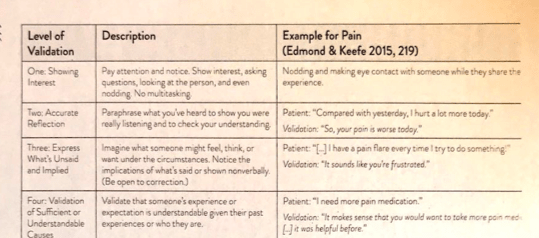
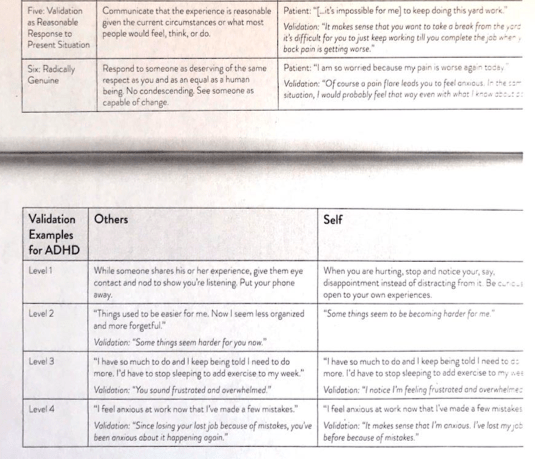
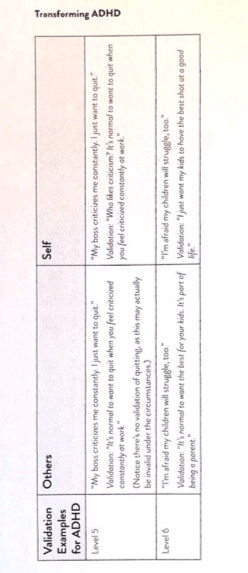
Examples of Six Levels of Validation

This is from the book I co-wrote, TRANSFORMING ADHD (I’m allowed to post some of the book). I hope you find it of use. It’s less glamorous-looking than I’d like, but if you knew my schedule, you’d understand. Besides, it’s all about the content, right?

Recent Resources for ADHD

Understanding ADHD

Brief, fun video on what it is that accurately reflects the latest and greatest understanding.

Getting what you want when you have it

Effective interventions and therapies This gets you to the blog of the American Professional Society of ADHD and Related Disorders, which was partly formed to spread the word about evidence-based practices.

Practices Christine Carter, who’s connected to the Greater Good Science Center at UC Berkeley, offers a free ebook on ways to play the short game to win the long game. Go back and click on Practices to get to her site and the ebook link.

Coaches We still need good research on ADHD coaches, but what research we now have suggests high satisfaction from those who use them. Thing is, they can cost many quite a bit. A coach through Edge, for example, costs $400 for an initial session and then $125/week (if interested, go back and click on Coaches).

More Click on More for two resources that I previously posted. They remain awesome.

Ugh! False Rumors about Fidget Spinners

I start with “ugh!” because I paid for the Special Edition of TIME today on THE SCIENCE OF LEARNING and opened it up by chance to an article with a picture of a child holding a fidget spinner with the caption, “Fidget spinners can help children with ADHD focus.” WT*? I thought. Is the rest of the magazine going to present false claims? I scoured through the one-page article looking for a research citation, wondering whether the latest research shows something different than earlier studies (Fidgeting: Spin vs. Science).

Well, the article had no research cited. So I pulled up pubmed.gov to check on the latest. I found a 2020 study. As prior research, it shows that fidget spinners DECREASE kids’ ability to focus (https://pubmed.ncbi.nlm.nih.gov/29676193/).

The FIU researchers found, “Children’s use of fidget spinners was associated with poorer attention across both phases of treatment.” They concluded, “Fidget spinners negatively influence young children with ADHD’s attentional functioning, even in the context of an evidence-based classroom intervention.”

A glance at other recent research revealed that there are now battery-powered fidget spinners that some kids are swallowing.

So I ended up learning something at least.

The Frontier of ADHD Interventions

In my last post, Let the Games Begin?, I shared the recently approved video game prescription for ADHD and this got me thinking about other interventions on the frontier… 

Trigeminal Nerve Stimulation. In the spring of 2019, the FDA approved TNS as a “treatment” for childhood ADHD based on research out of UCLA:  here.

The device the researchers used is called Monarch eTNS. It sends gentle electrical pulses to the trigeminal nerve, which then leads to stimulation of various brain regions.

For a user-friendly description of the research, read this.

Neurofeedback. A 2020 review by scholars from several countries found it useful for children with ADHD: here.

Other research suggests its promising use with adults, too, including research out of MIT (here). Also see here.


Let the Games Begin?

The latest prescription for childhood ADHD is a game. EndeavorRx is its name. Want to see it? Go to https://www.cnbc.com/2020/06/17/video-endeavorrx-is-first-video-game-approved-by-fda-to-treat-adhd.html.

The FDA approved it for children ages 8-12…the first game it has EVER approved as a prescription.

Apparently, the research behind it, out of UCSF, was convincing… https://www.ucsf.edu/news/2020/06/417841/fda-approves-video-game-based-ucsf-brain-research-adhd-therapy-kids

To some….  See some criticisms here.

If you’re interested but outside the age window, you might like to know this: In 2013, Nature published the results of a study on a game called Neuroracer showing that six weeks of training with the game improved older adults’ attention. How old are we talking? 60-85 years of age. For more see https://www.ucsf.edu/news/2013/09/108616/training-older-brain-3-d-video-game-enhances-cognitive-control.

Under 60 and over 12? Well, UCSF’s working on games for various ages and abilities. Find them at https://neuroscape.ucsf.edu/technology/.

A spoonful of sugar helps the medicine go down I guess.

Twitter, Trolls, and Tips

While thinking about the ways we’ve responded to our pandemic (mask vs. no mask, cooperate vs. resist), I ran across a Twitter post on shruggers vs. stockpilers and then watched the first part of the latest Trolls movie, where trolls split up by music genre. After, I saw an article declaring we’ll soon have two “classes” of individuals:  the protected and the vulnerable. Ack! So much division! It inspired me to come back to my blog to share some tips for responding to uncertainty. They are from D. Mosquera and K. Steele out of the Institute for the Study of Trauma and Personality Disorders (sigh…more categories…so many categories).

kids-5056458_1280

Tip 1: Avoid listening to/reading news constantly and especially before bed.

Instead schedule a time to update, once or twice a day (max), and stick to facts vs. sensationalism.

Tip 2: Set up a daily routine

Sleep, Hygiene (you’ll likely feel better), Healthy Eating, Exercise, Outside Time, Connection (but maybe avoiding the Neil Diamond kind), Mindfulness, Hobbies

Tip 3: Focus on tasks that depend on you and consider that staying home may be heroic (I’d add without judging others who do otherwise as bad)

Tip 4: Stay present-oriented

One day at a time, One week at a time. Find humor, playfulness, interest, and meaning where you can.

I hope these tips help. Here’s something to remember that also may, especially when our minds want an “us vs. them” of one sort or another…that I got from Tara Brach:

The Buddha said, “Our fear is great but greater yet is the truth of our connectedness.”

Try these for increased intimacy

Okay, I just came back from hearing Fiona Kenshole, my dream agent, speak, and she referred to this 2015 New York Times article about 36 questions to ask to “fall in love” that inspired this book. She got me when she said the article was based on a study.

My heart fell when I discovered the study came out over 20 freakin’ years ago. Why had I never heard of it? Well, better late than never.

Turns out these questions are worth a try. The Greater Good Science Center at UC Berkeley gives you the instructions here.

I’m going to try them. If you do, I’d love to know what happens.  romance-2004799_1920

Brain-Training Game that’s the Real Deal: dual n-back

I have a confession. I love my brain. It’s my most prized possession though it falls short of genius and may fall way, way short of it. Because I value it, I do my best to protect and enhance it.

nerves-2926087_1920So…when I came across this article about a 2017 study at John Hopkins University showing increased working memory and brain activity changes after playing dual n-back, I had to dig deeper (actual study).

I found many studies examining dual n-back that show promising results for working memory (WM), including a 2019 study out of SUNY (The State University of New York) where the researchers conclude, “The findings provide evidence that n-back training enhances distinct neural processes underlying executive aspects of WM.”

If you are as excited about this possibility as I am, here’s a free version of dual n-back.

Stepping over dollars to pick up pennies: What works for optimal cognitive functioning

Hot news out of Israel (Bar Ilan University) and Los Angeles (UCLA):  There’s a way to increase cognitive functioning among children with ADHD that is FREE and leads to BIGGER change than other non-chemical interventions.

What is this magic they speak of? Exercise.

Researchers searched through studies published between 1980 and 2017 on various non-pharmacological interventions for cognitive functions among children with ADHD and narrowed these down to the most trustworthy studies. One of the requirements the researchers had was that the study included an objective measure of cognitive functions.

They examined the effects of several non-pharmacological interventions–neurofeedback, cognitive-behavioral therapy, cognitive training, and physical exercises (aerobic)–and found all the interventions associated with desired changes. Physical exercise, however, rose to the top with the largest average effect size. Granted 18 studies across four interventions is small; however, the results are consistent with tons of research on the association between exercise and optimal physical, emotional and cognitive functioning.

The study.

So this is what my title is about…we often step over the dollars of optimal functioning and well-being to pick up pennies. The dollars are regular physical exercise (aerobic), enough sleep, and healthy eating. The pennies are the skills, strategies, games we may play with ourselves (fun or otherwise) that we often seek instead. The pennies matter; I’m just suggesting you pick up the dollars first.

My two cents. Or dollars. : )   

Blog at WordPress.com.

Up ↑